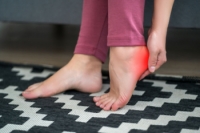
Custom Foot Orthotics help in providing relief for painful foot problems or an injury, especially for those who must walk, or stand excessively on the job or in every day activities.
The mechanical properties of the Custom Foot Orthotic help to maintain the normal positioning of the bones in the foot, the joints in the ankle and knees leading up to the hips and lower back. The muscles and ligaments holding these bones in their intended anatomical positions are prevented from over stretching and becoming lax over time.
With enough functional correction from a Custom Foot Orthotic, the foot structure can be aligned to give more propulsion, making walking, running and even cycling more efficient biomechanically.
Along with aligning the foot structure, the Custom Foot Orthotic reduces muscular fatigue and helps to promote more efficient muscle performance thus enhancing performance during the gait cycle.
Below is an example of a foot without the corrective support of an orthotic and then another example of the same foot with a Custom Made Foot Orthotic from POL correcting and supporting the foot. Notice the difference a well made Custom Foot Orthotic makes!

Foot Orthotics are constructed from various materials consisting of plastics, foam, rubbers, and cork composites that are utilized for their mechanical properties.
The main similarity of all Foot Orthotics is the principle of their structure. The core is comprised of a plastic material more commonly referred to as the shell. External support structures on the underside of the shell material are utilized for balance and support inside the footwear; these are commonly referred to as extrinsic posts. Soft padding is placed on the underside and the topside to absorb compression forces when walking and running, this includes the top covers, underlay materials and arch fills.
All of these materials have the goal of improving foot function and minimizing the stress forces that cause foot deformity and pain.
Dependent on the reason for the prescription of Foot Orthotics, all of the above mentioned materials can be utilized in many combinations to achieve three broad categories of Foot Orthotics:
|
Chicago Office 773-477-3668 |
Highland Park 847-432-6400 |
Quick starts and stops and lots of movements from side to side are the characteristics that make tennis challenging -- and stressful on your feet. Amateur and professional tennis players alike are prone to injuries of the foot and ankle, primarily from repeated lateral motions and quick stopping and starting. Clay and crushed stone courts help players slide better, and are considered the safest surfaces on which to play. Asphalt, concrete, rubberized, or carpeted courts don't allow sliding, and are not as healthy for your feet.
Common tennis injuries include ankle sprains, stress fractures, plantar fasciitis, and tennis toe. If you experience recurring or persistent pain, please contact our office for an evaluation.
The best way to prevent foot injuries from tennis is to make sure you condition yourself. This includes building all-around body strength and flexibility; stretching the muscles (particularly in your calves) before, during and after play; drinking lots of water; and wearing the right shoes.
Tennis Shoes
Tennis shoes need lots of cushioning and shock absorption to deal with all the forces placed on your feet during play and to keep your foot and ankle stable. Be sure to choose shoes specifically for racquet sports; running shoes, for example, don't have the support needed for the side-to-side movements common to tennis. Look for a tennis shoes that have a reinforced toe, wiggle room in the toe box, padding at the ball of the foot, sturdy sides, a low, well-cushioned heel that is not flared, and a firm heel counter for support.
When shopping for tennis shoes, follow these tips:
If you have a comment or question, please fill out the form.